
Blog Post
Ripken’s Streak: Why 2,131 and 2,632 Tell Different Stories

The night Cal Ripken Jr. passed Lou Gehrig is Baltimore’s great milestone. The 501 games that followed, and the production inside the streak, deepen its meaning.
Two numbers tell different parts of Cal Ripken Jr.’s consecutive-games story. At 2,131, he moved beyond Lou Gehrig. At 2,632, the streak finally stopped. Remembering only the first number captures the celebration while leaving more than three seasons’ worth of additional appearances outside the frame.
On September 6, 1995, Ripken surpassed Gehrig’s 2,130-game mark at Camden Yards. The National Baseball Hall of Fame’s account locates the defining moment after the top of the fifth inning, when the warehouse display changed to 2,131. The celebration eventually drew Ripken into a lap around the field.
He continued until September 20, 1998, when he took himself out of the lineup with the streak at 2,632. Subtract the record-breaking appearance from the final total and the result is 501 more games. The famous evening was a breakthrough, not a finish line.
The batting record inside the attendance record
A streak measures consecutive participation. It does not, by itself, tell a reader how well someone played. Ripken’s season statistics supply a second dimension: the Orioles were receiving substantial offensive production during parts of that extraordinary run.
MLB’s official figures list a .318 batting average and 27 home runs in 162 games in 1983. In 1991, he played 162 games again, hit .323 and finished with 34 homers and a .940 OPS. Those were different seasons within the same uninterrupted sequence. Availability and strong hitting were operating together.
The record also contains variation. In 1992, Ripken’s average was .251 and his OPS .689; in 1993, the corresponding figures were .257 and .749. In 1995, the year of the historic celebration, he hit .262 with 17 home runs in 144 games. Those totals describe full seasons, rather than isolated portions of the streak.
This is a more useful portrait than imagining an identical performance repeated thousands of times. The daily sequence held while the offensive results moved. A durable player still has better years, difficult stretches and adjustments. The streak did not erase the normal demands of evaluating a hitter.
What the two numbers preserve
The appeal of 2,131 is that it gives a vast achievement a visible moment. A changing numeral on the warehouse and a player greeting fans turn an accumulation into a scene people can revisit. That connection also makes the ballpark part of the memory; the B&O Warehouse’s place in Camden Yards extends well beyond its architecture.
The value of 2,632 is different. It asks the reader to look past the ceremony and consider the continuation. There was still another lineup, another opponent and another day of work after the record belonged to Ripken.
Neither number needs to become a universal prescription for how every player should be used. This is a singular historical achievement, not a workload plan for a modern roster. Appreciating it does not require assuming that rest is a failure or that another player’s circumstances should match Ripken’s.
Together, the numbers preserve both the night Baltimore celebrated and the larger career of persistence around it. The statistics add something essential: Ripken was accumulating performances as well as appearances. That is the fuller story behind the Iron Man shorthand.
Research cutoff: November 12, 2026, 2:05 p.m. Eastern. Historical feature; no claim of firsthand attendance. Statistical comparisons and interpretation are Birdland Today analysis.
Sources: National Baseball Hall of Fame: Ripken breaks Gehrig’s record; MLB official season-by-season hitting statistics.
Image: Cal Ripken Jr. practicing his swing at Tiger Stadium in Detroit in 1993, not the September 1995 record-breaking game. Rick Dikeman (Rdikeman) / Wikimedia Commons, CC BY-SA 3.0. Resized for display; photo adaptations retain the same license.

Keep reading
Related Blog Posts
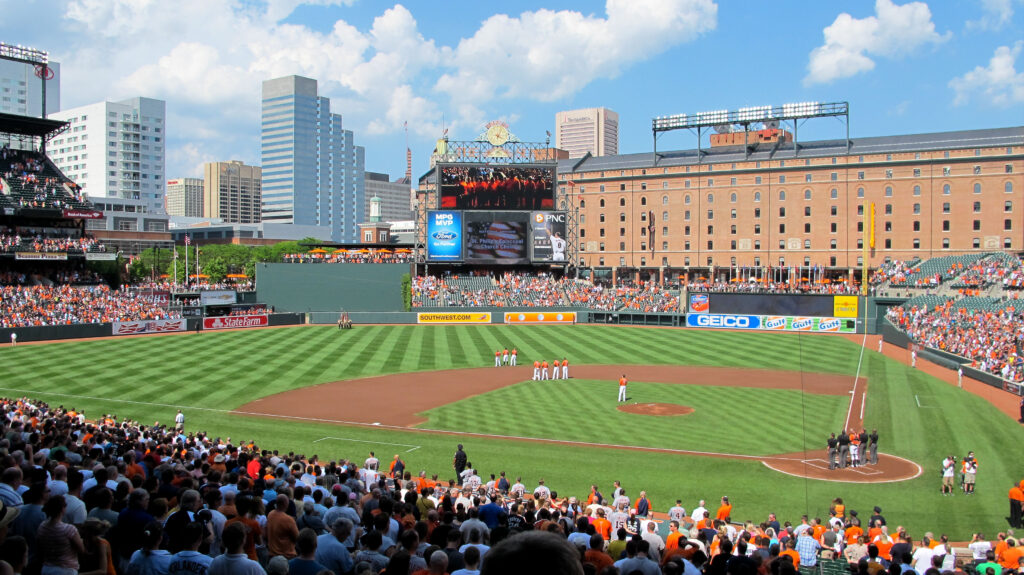
How the B&O Warehouse Gave Camden Yards Its Baltimore Identity
The B&O Warehouse survived a demolition threat before Camden Yards opened in 1992. Its preservation connected the Orioles’ new home to Baltimore’s railroad past.
Read Post
How the Orioles Closed Out the 1983 World Series
Murray’s two homers, Dempsey’s extra-base hits and McGregor’s shutout powered Baltimore’s 1983 World Series clincher. Revisit the decisive game through MLB’s records.
Read Post