
Blog Post
How the B&O Warehouse Gave Camden Yards Its Baltimore Identity
BALTIMORE BASEBALL HISTORY
The B&O Warehouse was threatened with demolition before Camden Yards opened. Keeping it gave the Orioles’ new home a connection to Baltimore that fresh brick alone could not supply.
The most distinctive building at Camden Yards was there long before the ballpark. The B&O Warehouse’s survival helps explain why the Orioles’ home feels attached to a particular city rather than simply decorated to look old.
Oriole Park at Camden Yards opened April 6, 1992, according to the Maryland Stadium Authority. The authority describes the project as a return to an intimate, traditional baseball setting with modern amenities. The warehouse supplied something different: a surviving piece of the site’s working history.
A railroad building before a baseball landmark
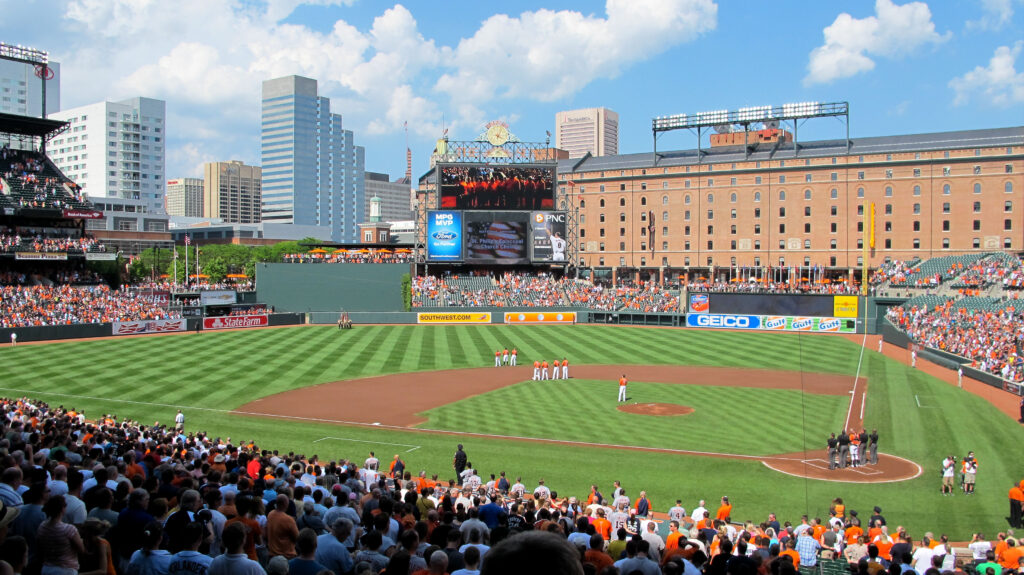
Baltimore Heritage dates the start of warehouse construction to 1899. A five-story addition was completed in 1905. The narrow building extended four blocks along South Eutaw Street, a shape dictated by its place in a busy rail yard.
Its original purpose was moving and storing freight. The Orioles did not commission that long brick wall as a backdrop. Baseball arrived after the railroad had already established the building’s form and the surrounding landscape.
That sequence matters. A new structure can borrow the appearance of an earlier era; an existing building carries an actual earlier use. At Camden Yards, the relationship between the field and the warehouse makes that distinction visible.
Preservation was a choice
According to Baltimore Heritage, the warehouse remained active through the 1960s and was largely abandoned by the 1970s. Stadium plans threatened it with demolition in the 1980s. The organization and Maryland state Sen. Jack Lapides advocated for keeping the warehouse and rehabilitating Camden Station.
The stadium authority, with Orioles support, incorporated the building into the new complex. That outcome was not inevitable. Preserving an old structure requires a project to accommodate what is already there instead of treating every existing feature as an obstacle.
Our reading of that history is that the warehouse’s importance goes beyond its appearance in photographs. It gave the new ballpark a physical relationship with Baltimore’s industrial past. The project could introduce a new place for baseball while retaining a recognizable part of the city.
A useful way to look at the park
The stadium authority lists 556,000 red bricks among the ballpark’s construction materials and identifies Hellmuth, Obata & Kassabaum as its architect. Those facts help distinguish the new stadium project from the older warehouse it incorporated.
For fans studying Camden Yards, that is a useful starting point: separate what was newly designed from what was preserved, then consider how the two work together. The result is more interesting than the loose description of a ballpark that looks old-fashioned.
The warehouse makes the setting specific. Its scale and position reflect a railroad site that preceded the Orioles’ arrival there. Keeping it allowed the ballpark to build on that history instead of replacing the whole scene.
For another look at Baltimore’s baseball past, read how the Orioles closed out the 1983 World Series.
Sources and historical context
Maryland Stadium Authority: Oriole Park at Camden Yards—opening date, design attribution, construction materials and the authority’s description of the project.
Baltimore Heritage: Baltimore & Ohio Warehouse at Camden Yards—warehouse construction, railroad use and preservation history. Historical interpretation is Birdland Today’s. Research cutoff: November 11, 2026, 8:00 a.m. Eastern. This is a history feature, not a report of a new stadium project.
Photo: Oriole Park at Camden Yards, with the warehouse beyond right field, before a game on June 1, 2013, by Keith Allison, via Wikimedia Commons, CC BY-SA 2.0. Responsive resizing or display cropping may apply; photo adaptations retain the same license. This archival photograph does not depict the 1992 opening.

Keep reading
Related Blog Posts

Dylan Beavers’ Rookie Vote Leaves a Bigger Orioles Question
Dylan Beavers reportedly received a Rookie of the Year vote. His official 2026 numbers frame the larger Orioles questions about development and playing time.
Read Post
Orioles Contact Review: Fewer Strikeouts Is Only Part of the Goal
Baltimore’s 2026 walks and strikeouts show why better contact must preserve on-base ability and power. A sourced look at the Orioles’ offensive challenge.
Read Post
MLB’s New Cap Timeline Leaves the Central Labor Dispute Unresolved
MLB’s proposed 2028 cap-and-floor start addresses a transition problem. Players still oppose the underlying system as the December 1 deadline approaches.
Read Post