
Blog Post
Orioles Contact Review: Fewer Strikeouts Is Only Part of the Goal
OFFENSIVE ANALYSIS
Baltimore’s 2026 MLB listing shows a strikeout in roughly one of every four plate appearances. The offseason challenge is improving contact without giving away walks and power.
The Orioles’ offensive review should begin with a distinction: putting the ball in play more often is a useful goal only if the resulting contact helps the lineup. An early swing at a poor pitch can reduce a strikeout total without making an offense better.
MLB’s official 2026 team hitting listing gives Baltimore 1,518 strikeouts and 586 walks in 6,079 plate appearances. Dividing each total by plate appearances produces a 25.0 percent strikeout rate and a 9.6 percent walk rate, rounded to one decimal place. Those are separate outcomes worth examining together as the Orioles plan for 2027.
Use the same denominator
A strikeout rate based on plate appearances answers a clear question: how often did a trip to the plate end in a strikeout? Using at-bats instead would exclude walks and several other outcomes, changing the question and making comparisons misleading if the denominators do not match.
The walk total here includes 19 intentional walks. Consequently, 9.6 percent is a total walk rate, not a measure of how often Baltimore’s hitters earned an unintentional walk. The difference matters when evaluating decisions against pitches outside the strike zone.
These team totals also do not identify which hitters chased, which struggled to make contact in the zone or which reached two strikes after taking hittable pitches. Those explanations require pitch-level evidence. A season strikeout count alone cannot diagnose an approach.
Contact has a quality requirement
Baltimore’s listing includes 199 home runs, a .314 on-base percentage and a .396 slugging percentage. An offseason plan must account for all three dimensions: reaching base, making contact and doing damage. None can be evaluated completely by looking at strikeouts alone.
Consider a hypothetical hitter who replaces a strikeout with a weak groundout. The ball has entered play, and an error or unusual defensive result is possible, but the ordinary outcome still costs an out. Replacing a strikeout with a hard line drive presents a different opportunity. Treating both changes as equivalent would miss the point of the adjustment.
Our view is that Baltimore should pursue better swing decisions and more productive contact together. That is a more useful objective than adopting a blanket instruction to swing earlier or shorten every swing. The right adjustment can differ from hitter to hitter.
What would make the review more convincing?
A player-by-player assessment should examine contact on strikes, swings outside the zone and results after reaching two strikes. It should also distinguish changes in the hitters receiving plate appearances from changes in how returning players performed.
That would help answer an important roster question: can an improvement come from development, a different allocation of playing time or an outside addition? The aggregate totals cannot choose among those options, and this article does not claim the Orioles have adopted a particular plan.
The practical standard for 2027 should be a more complete offensive result. A lower strikeout rate would be encouraging alongside preserved walks and damaging contact. By itself, it would be an incomplete verdict.
For another example of separating activity from effectiveness, read our Orioles stolen-base efficiency review.
Sources and methodology
MLB official Orioles 2026 team hitting statistics. Rates calculated by Birdland Today: 1,518 ÷ 6,079 and 586 ÷ 6,079. This retrieved listing reports 161 games; totals are reproduced as listed rather than represented as a reconstructed 162-game dataset. No league ranking or player-level cause is inferred.
Research cutoff: November 10, 2026, 8:00 a.m. Eastern. Commentary and hypothetical examples are Birdland Today’s analysis.
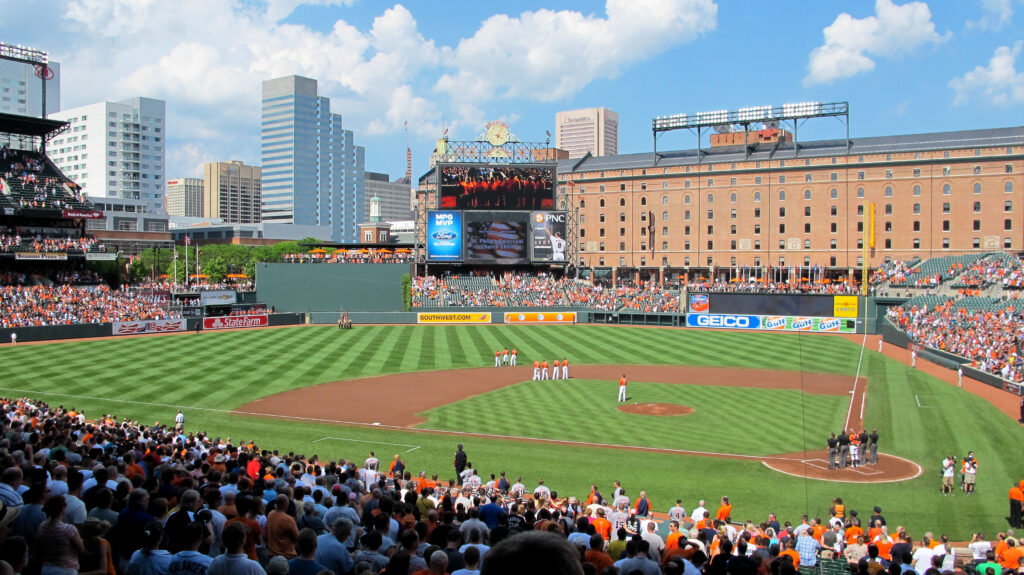
Photo: Archival view of Oriole Park at Camden Yards before a game on June 1, 2013, by Keith Allison, via Wikimedia Commons, CC BY-SA 2.0. Responsive resizing or display cropping may apply; photo adaptations retain the same license. The photograph does not depict the 2026 season.

Keep reading
Related Blog Posts
MLB’s New Cap Timeline Leaves the Central Labor Dispute Unresolved
MLB’s proposed 2028 cap-and-floor start addresses a transition problem. Players still oppose the underlying system as the December 1 deadline approaches.
Read Post
Brandon Young’s Slower Splitter: What the Orioles Can Learn
MASN’s reported splitter samples show lower velocity and better results for Brandon Young. What the trend tells the Orioles—and what still needs verification.
Read Post
Orioles Stolen-Base Review: Efficiency Before More Attempts
Baltimore recorded 78 steals and 33 caught stealing in MLB’s 2026 listing. The numbers make a case for better opportunities before simply running more often.
Read Post