
Blog Post
MLB’s New Cap Timeline Leaves the Central Labor Dispute Unresolved
LABOR ANALYSIS
Moving a proposed payroll system to 2028 gives clubs more time to prepare. It does not resolve the players’ objection to the system itself.
Major League Baseball’s revised labor offer changes the timetable for its proposed salary cap and floor. The harder question remains whether owners and players can agree on the economic framework before their current agreement expires on December 1.
In the November 3 proposal, MLB projected a 2028 payroll ceiling of $258.2 million and a floor of $180.2 million. Those are negotiating positions, not rules governing Baltimore’s current offseason. The distinction matters for a club trying to strengthen its roster while the sport negotiates a potentially different financial structure.
A transition question and a fundamental disagreement
MLB says the later implementation would give clubs time to prepare. Existing contracts make a transition more complicated than simply announcing a number and asking every team to comply immediately.
The Players Association’s response focuses on a different question: whether a cap should exist. In its November 3 statements, the union argued that management’s proposals would reduce compensation and restrict players’ rights. These are the union’s assessments of the offer, rather than established conclusions about an agreement that has yet to be reached.
The two positions help explain why a revised proposal is not automatically evidence that an agreement is close. One side can address the mechanics of introducing a system while the other continues to oppose the system’s central feature.
What the Orioles can control
Baltimore’s baseball decisions now take place alongside that uncertainty. A possible labor stoppage can influence planning, but it does not establish the reason behind every unsigned free agent or uncompleted trade. Individual decisions still require individual reporting.
Birdland Today’s view is that urgency should sharpen the Orioles’ preparation. It should not become permission to invent evidence of an offer, a negotiation or a near agreement. The club needs a clear understanding of its own players, its roster weaknesses and the potential additions that could address them.
A future payroll framework would change the boundaries of that work. It would not do the work. Identifying a useful pitcher, developing a young hitter and evaluating a contract remain baseball judgments. Neither a ceiling nor a floor can guarantee that an organization makes them well.
That is also why two headline payroll figures are insufficient to evaluate an entire labor agreement. Definitions of covered payroll, revenue and existing commitments affect how a system would operate. The complete terms deserve scrutiny before fans treat a proposal as a forecast of Baltimore’s eventual spending.
The evidence that would signal progress
Over the remaining weeks, substantive movement will matter more than the tone of a headline. A meaningful change in the economic framework, a response to the other side’s central concerns or a joint acknowledgment of progress would offer more useful evidence than the mere occurrence of another meeting.
Public positions do not reveal everything discussed privately. They nevertheless establish an important limit on what can responsibly be claimed. A transition date has changed. The public dispute over a cap remains.
The potential events should also be kept separate. An offseason lockout is not the same event as a delayed Opening Day or canceled regular-season games. Each has a different timetable and would depend on subsequent decisions. A lockout is an action taken by management; it is distinct from a players’ strike.
An unchanged subjective estimate
As of the November 10 research cutoff, Birdland Today’s subjective estimate remains an 85% chance that owners begin a lockout after the December 1, 2026 expiration of the current agreement and before a successor agreement is reached. That is unchanged from November 3, a movement of zero percentage points.
This is an editorial assessment based on public information, not a statistical model, betting price or claim of inside knowledge. It does not estimate the probability of missed regular-season games. The later proposed implementation date changes the owners’ offer, but it does not establish agreement on the cap dispute that drives the assessment.
For Baltimore, preparation should continue across more than one possible labor outcome. The organization can clarify the team it wants to build while the parties determine the rules under which it will operate.
Sources and credits
- Associated Press: MLB’s November 3 revised offer.
- MLB: revised cap and floor timeline.
- MLBPA: November 3 bargaining statement.
Reporting date: November 10, 2026. Research cutoff: 3:33 a.m. Eastern. Forecast and analysis are Birdland Today’s original editorial judgments.
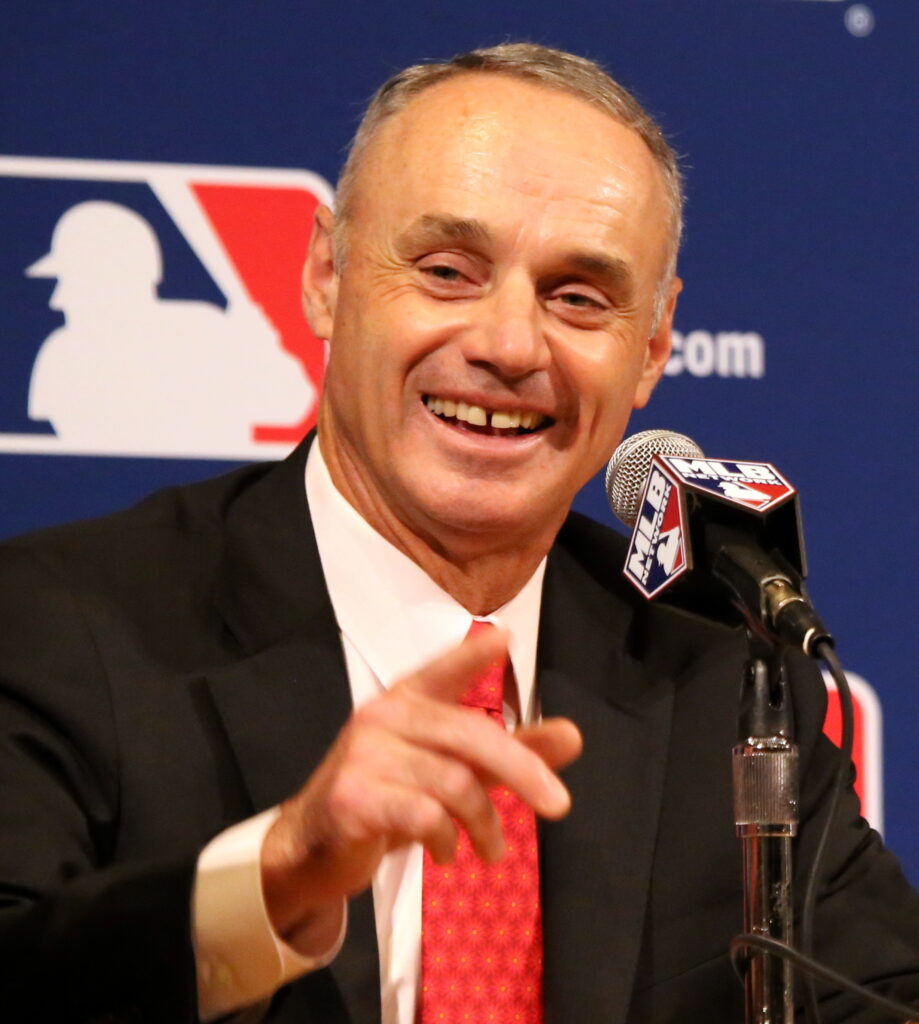
Photo: Rob Manfred, December 7, 2015, by Arturo Pardavila III, via Wikimedia Commons, CC BY 2.0. Archival photograph, cropped; not a photograph of current negotiations.

Keep reading
Related Blog Posts
Brandon Young’s Slower Splitter: What the Orioles Can Learn
MASN’s reported splitter samples show lower velocity and better results for Brandon Young. What the trend tells the Orioles—and what still needs verification.
Read Post
Orioles Stolen-Base Review: Efficiency Before More Attempts
Baltimore recorded 78 steals and 33 caught stealing in MLB’s 2026 listing. The numbers make a case for better opportunities before simply running more often.
Read Post
How the Orioles Closed Out the 1983 World Series
Murray’s two homers, Dempsey’s extra-base hits and McGregor’s shutout powered Baltimore’s 1983 World Series clincher. Revisit the decisive game through MLB’s records.
Read Post