
Blog Post
Shared Media Revenue Leaves Baseball’s Central Labor Dispute Unsettled
Agreement on sharing media money gives baseball’s labor talks a building block. It leaves the central payroll dispute unsettled a week before the current agreement expires.
Baseball’s players and owners have found common ground on distributing media revenue, but the development does not establish that a new collective bargaining agreement is close. For Orioles fans following the offseason, that distinction is the most useful way to read the latest negotiations.
The players’ association announced Monday that it had accepted management’s proposal to divide major league media revenue equally among the 30 clubs. The union has not accepted a salary cap, which remains central to the owners’ proposed economic structure.
Those positions can coexist. A negotiation can narrow differences on one subject while remaining divided over the framework that would govern the larger agreement. Treating the media announcement as either meaningless or a completed deal would miss that reality.
Two decisions about different flows of money
Revenue sharing concerns the distribution of money among clubs. A payroll cap limits spending under negotiated rules, while a floor establishes a minimum. Supporting a more equal distribution of resources does not necessarily mean supporting the same restrictions on player compensation.
The owners have argued that their preferred structure would improve competitive balance. The players oppose a hard cap and favor a different approach to addressing economic disparities. Commissioner Rob Manfred’s public comments last week reinforced management’s commitment to the cap-and-floor system.
Monday’s development therefore offers a possible component of a larger agreement. It does not remove the need to settle how that component fits with the remaining terms. The practical question is whether the shared position helps the parties bridge their central disagreement.
For Baltimore, more equal resources across the sport could matter. But no proposal alone establishes the Orioles’ next payroll or their next roster move. The final effects would depend on the agreement ultimately signed and the decisions made by individual clubs.
Resources and competitive choices
There is a difference between giving a club enough money to compete and ensuring that it uses those resources to improve its team. That distinction sits behind arguments about incentives, spending requirements and accountability for revenue-sharing recipients.
Fans have a reasonable interest in both questions. A club cannot scout or develop its way around every resource disadvantage. Equally, receiving additional money does not automatically produce an improved roster. An economic system needs to be evaluated through the behavior its rules encourage.
That makes the details of enforcement important. A proposal described as helping competitive balance should be assessed by what clubs would actually be required or encouraged to do. A stated goal, however appealing, is not a substitute for an accepted mechanism.
The same care applies to claims about player compensation. The way a system divides growth, allocates risk and limits bargaining freedom matters alongside its headline payroll numbers. A cap figure or spending floor cannot explain the entire relationship.
The international entry system remains part of the talks
The union’s November 20 proposal sought changes to international amateur signing while opposing an international draft. It emphasized increased bonus opportunities, greater flexibility and measures intended to prevent improper early agreements with young players.
Those discussions concern future players as well as current major leaguers. Entry rules shape the teams a prospect can negotiate with, the money available and the leverage attached to a professional opportunity. They also affect how organizations build their development pipelines.
For a team investing in scouting and player development, the final framework could influence choices for years. That does not permit a prediction about which particular player Baltimore would sign under hypothetical rules. It does make the international discussion relevant to the club’s offseason outlook.
Movement on that subject also should not be mistaken for resolution of the salary-cap dispute. Different parts of collective bargaining can proceed at different speeds. More proposals mean more information about the parties’ positions; they do not necessarily mean that a final compromise is imminent.
Transactions do not resolve the collective question
The market continues alongside the negotiations. The Associated Press reported a nine-year, $450 million agreement between Tarik Skubal and the Mets, citing a person familiar with the talks. The reported deal illustrates that major commitments remain possible while the labor deadline approaches.
An individual contract, however, answers a different question from a collective bargaining agreement. It shows that a player and club found acceptable terms. It does not establish that a lockout has been avoided or that either side has private certainty about the larger negotiation.
Orioles transactions should be evaluated with the same distinction. Assess the player, price and roster fit. A signing or trade would not, on its own, justify assuming that Baltimore knows when the labor dispute will end.
A precise forecast
The current agreement expires December 1 at 11:59 p.m. Eastern. Expiration does not itself constitute a lockout; that would be an owners’ action. Nor would a winter lockout necessarily mean lost regular-season games.
Birdland Today’s subjective estimate remains an 85 percent chance that owners impose a lockout after the current agreement expires and before a successor agreement is reached. That is unchanged from the November 17 estimate, a difference of zero percentage points. It is editorial judgment based on public information, not a statistical model or private reporting.
The media-revenue development is a reason to recognize progress. Verified movement on the central economic framework would be a stronger reason to change the outlook. Until then, following offseason business and acknowledging substantial labor risk remain compatible positions.
Sources: MLBPA’s November 23 announcement; MLBPA international proposal; Manfred’s public position; AP’s Skubal agreement report; current Basic Agreement.
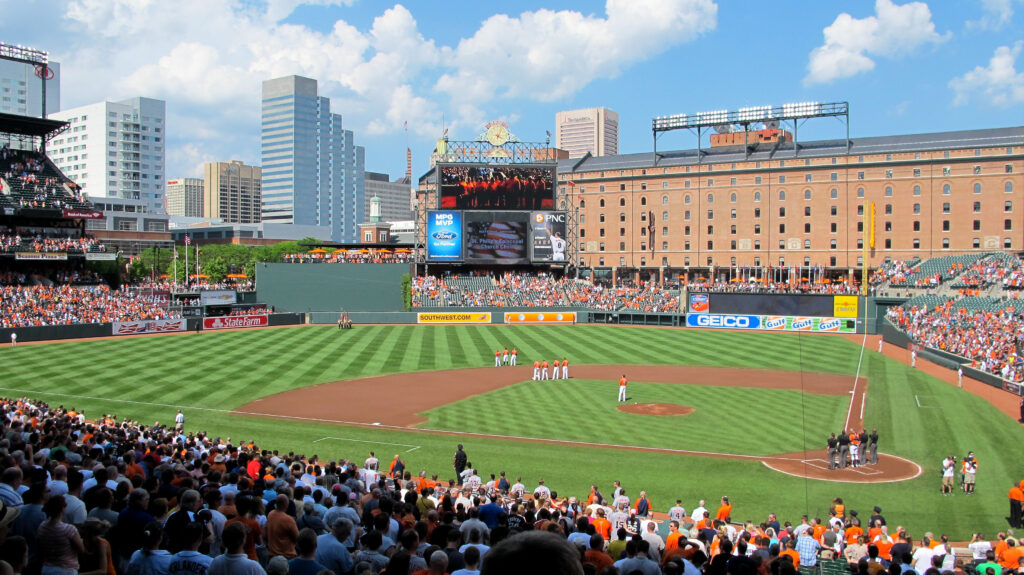
Photo: Oriole Park at Camden Yards, June 1, 2013. Keith Allison, CC BY-SA 2.0, via Wikimedia Commons. Resized. Illustrative archival stadium photograph, not a bargaining session or a current shutdown. Photo adaptations retain the same license.

Keep reading
Related Blog Posts
Freddy Peralta Gives Orioles Durability—and a Strikeout Question
The Orioles’ five-year Freddy Peralta commitment brings a durable workload and a question about recovering his earlier strikeout rate.
Read Post
Orioles’ Reported Luis Vázquez Return Adds Depth and an Offensive Test
Luis Vázquez is reportedly returning on a minor league deal. His Norfolk record shows the offensive test ahead of a larger role with the Orioles.
Read Post
Hunter Goodman’s Power Explains Orioles’ Reported Inquiry
Reported Orioles talks about Hunter Goodman did not advance. His 41 homers, including 25 on the road, explain the interest and remaining questions.
Read Post